
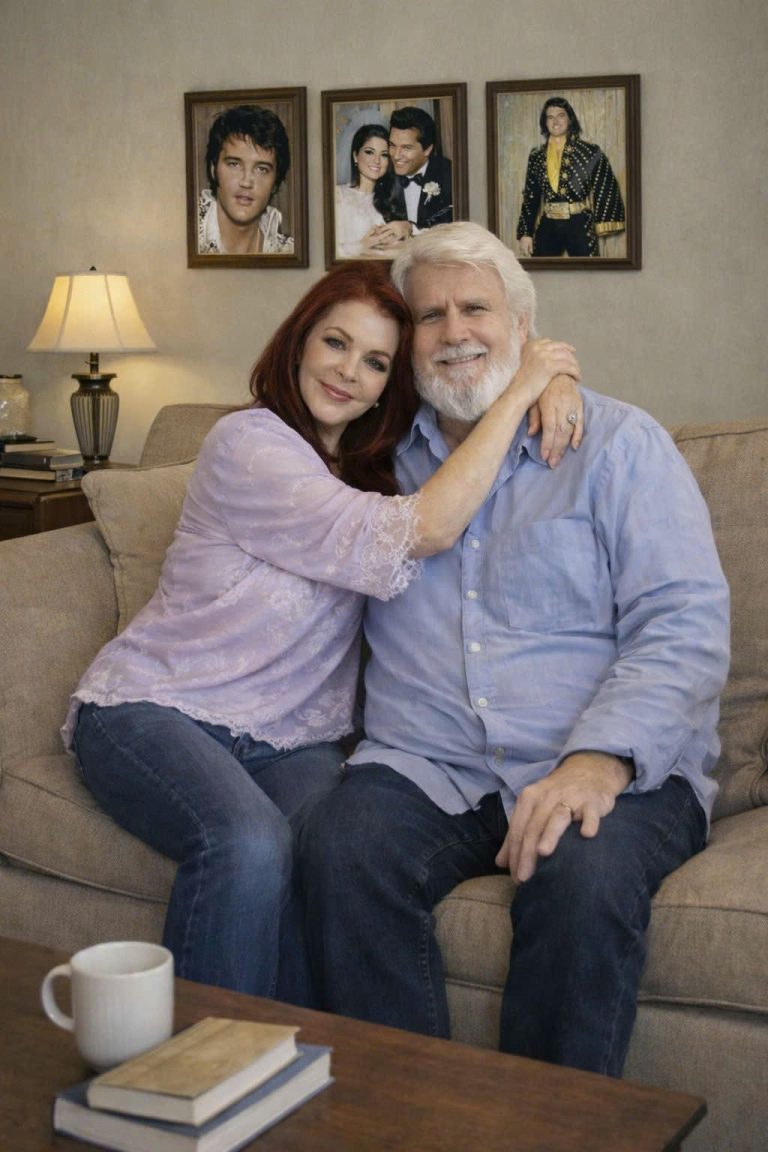
A quiet evening in Memphis unexpectedly became the center of worldwide attention when Bob Joyce and Priscilla Presley appeared together in a rare live interview inside their private home. The setting was unusually simple. There was no crowded stage, no cheering audience, and no elaborate television studio. Instead, cameras were placed carefully in a modest living room where the conversation unfolded with a calmness that masked a growing tension beneath the surface.
For many years, speculation surrounding Bob Joyce had quietly circulated across fan communities and online discussions devoted to Elvis Presley. Supporters of a controversial theory pointed to similarities in voice, facial features, and stage presence. Others firmly rejected those claims, describing them as nothing more than imaginative rumors fueled by the enduring legend of the King of Rock and Roll. Despite the skepticism, curiosity never disappeared. Every new photograph, every recorded performance from Joyce's church, and every unexpected detail seemed to revive the debate again.
That lingering mystery is precisely why this particular interview captured immediate attention. Seeing Joyce seated beside Priscilla Presley in the same room felt unusual to many viewers. The atmosphere appeared respectful and composed, yet a quiet sense of anticipation could be felt even through the camera. The interviewer began with gentle questions about music, memories, and the remarkable cultural impact Elvis Presley continues to hold decades after his passing.
Priscilla spoke with calm reflection, recalling moments from the past and the responsibility of preserving a legacy that still influences artists and fans across the world. Joyce responded politely but carefully. His answers remained measured, almost cautious, as if he understood that the conversation might eventually reach a point that had long been avoided.
That moment arrived sooner than expected.
The reporter paused briefly, clearly aware of the weight of the question about to be asked. Many watching later said the silence before it felt unusually long. Finally, the question emerged — the same one that had been whispered across countless discussions for years.
For a few seconds, Bob Joyce did not answer.
His eyes lowered, his hands folded together as if considering something deeply personal.
Then he spoke.
💬 "I am Elvis."
Six simple words.
Nothing more.
Yet the reaction inside the room was immediate and unmistakable. Witnesses later described a strange stillness that settled over everyone present. The interviewer appeared caught off guard, uncertain how to continue. Cameras remained fixed on Joyce's expression while the silence stretched longer than anyone expected. Priscilla Presley remained composed, offering no dramatic response, yet her thoughtful expression only added to the mystery surrounding the moment.
Within hours, recordings of the interview began spreading rapidly across social media platforms and fan communities. Supporters of the long-standing theory interpreted the statement as confirmation of something they believed for years. Skeptics, however, urged caution. Many insisted that context, interpretation, and emotional atmosphere could easily influence how a moment like this is understood.
Music historians and cultural commentators quickly joined the discussion. Elvis Presley remains one of the most influential figures in entertainment history, a performer whose life continues to inspire fascination decades after his official passing. Stories surrounding him have always carried a mixture of admiration, nostalgia, and mystery. That enduring fascination explains why even a single sentence spoken in a quiet living room can ignite global debate.
Yet what makes this moment particularly intriguing is not merely the statement itself. The true mystery lies in what followed — or rather, what did not follow. No detailed explanation appeared immediately after the interview. Neither Joyce nor Priscilla Presley offered further clarification before the conversation concluded.
Viewers were left with unanswered questions.
Was the remark meant literally, or was it symbolic in a way that has yet to be understood?
Did the statement reveal something deeply personal, or did the tension of the moment simply lead to words that surprised even the speaker himself?
The footage continues to circulate, studied and debated by fans determined to interpret every detail — every pause, every glance, every expression captured by the camera. Some believe the truth may eventually surface with time. Others suspect that the mystery itself may always remain part of the legend.
Because the story of Elvis Presley has never truly been simple. It has always existed somewhere between history and myth, between memory and imagination.
And after those six quiet words echoed through that Memphis living room, one thought continues to linger among those who watched the moment unfold.
Perhaps the greatest mystery in rock and roll history has not reached its final chapter yet.